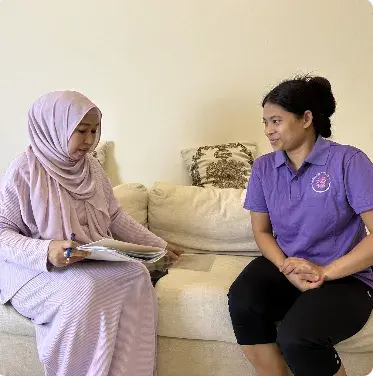
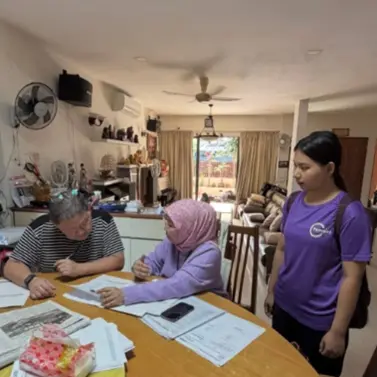
Care at home, by someone who lives with you
Many families want their parents to grow older at home, and a live-in caregiver in Singapore makes that possible: help with daily routines, company through the day and someone on hand at night. Femme5 matches families with helpers who have looked after older people before, and prepares them for your parent’s specific needs. Compared with elder care services that visit for a few hours, a live-in caregiver gives home care around the clock, which many families find the most practical form of home care services in Singapore.
What a live-in caregiver can help with
- Bathing, dressing, grooming and toileting
- Help with walking, transfers and moving safely around the home
- Medication reminders and keeping to a daily routine
- Preparing meals that suit your parent’s diet
- Accompanying your parent to clinics, day centres and outings
- Housework, laundry and keeping the home safe
- Company and conversation through the day
A domestic helper is not a nurse. Medical procedures such as injections, wound care or tube feeding should be done or supervised by trained healthcare staff. Read more in elderly caregiver vs domestic helper.
Is a live-in caregiver right for your parent?
A live-in helper tends to suit families where a parent needs help at several points in the day, should not be alone at night, or prefers a familiar face over changing visitors. It also helps when adult children work long hours and want someone at home who knows the routine.
How it compares with other options
- Visiting home care. Elder care services in Singapore that send staff for set hours can be a good fit when care is needed only at fixed times, or for nursing tasks a helper should not do. Some families combine visiting nurses with a live-in helper.
- Day centres. A day centre gives your parent activities and company while the family is at work. A helper can take your parent there and back and look after them in the evening.
- Residential care. When a parent needs skilled nursing around the clock, a nursing home may be the safer choice. Discuss this with your parent’s doctor.
The Agency for Integrated Care (AIC) lists the care options available in Singapore and is a good place to compare them.
How we match a caregiver to your family
- We learn about your parent. Mobility, health conditions, diet, language, routine and what a good day looks like.
- We shortlist helpers with caregiving experience. We look for previous elderly care, patience and the language your parent is comfortable in. Every caregiver we put forward has been screened through her certificates, an interview and a skills test.
- You interview. Ask about her past caregiving and how she would handle a difficult day.
- We prepare her for your home. Before she starts, we brief her on your parent’s routine and house rules. See how we pre-train helpers.
Choosing a maid for elderly care is about temperament as much as skills. Our article on how good agencies screen caregivers explains what to look for.
The hiring steps and MOM requirements
A live-in caregiver is employed on a Work Permit for a migrant domestic worker, so the Ministry of Manpower (MOM) rules for any full-time helper apply.
- Employers’ Orientation Programme (EOP). First-time employers must complete it at least 2 working days before the Work Permit application. If the employer is aged 60 or above with physical discomfort, or has a chronic medical condition, a representative may attend instead. See MOM’s EOP page.
- Work Permit, bond and insurance. The application and issuance fees are $35 each. You need a $5,000 security bond, medical insurance with an annual claim limit of at least $60,000 and personal accident insurance of at least $60,000.
- Arrival. She must pass a medical examination within 2 weeks of arrival. A first-time helper must attend the 1-day Settling-in Programme within 7 days of arrival before she starts work.
- Where she works. She may only work at the address declared to MOM. If she will care for your parent at a relative’s home, you must notify MOM first and have her written agreement. See MOM’s employment rules.
- Rest days. She is entitled to 1 rest day a week, and at least 1 rest day each month cannot be replaced with pay. Plan who will look after your parent on her day off.
If your parent needs help soon, an experienced transfer maid already in Singapore may be an option. A transfer needs her current employer’s consent.
Costs and support for families
If the person being cared for is a Singapore Citizen aged 67 or above and lives with you, you may qualify for the concessionary maid levy of $60 a month instead of $300. The concession is applied automatically once the person is added as a household member in MOM’s FDW eService. Some permanent residents also qualify. A person with disabilities who needs help with at least 1 activity of daily living can also qualify, with a doctor’s certification and a recommendation letter from AIC. A household can have at most 2 concessionary helpers, and only if there are 2 eligible persons. See our maid levy guide for the full rules.
Families caring for a parent who needs help with daily activities may also be eligible for support from the Agency for Integrated Care (AIC). Check the latest criteria on AIC’s website.
- Home Caregiving Grant. Up to $600 a month, depending on household income per person and the number of properties owned, for a family member who permanently needs some assistance with at least 3 of the 6 activities of daily living and does not live in a nursing home or other residential care institution. See AIC’s Home Caregiving Grant page.
- MediSave Care. A severely disabled Singapore resident aged 30 and above can withdraw up to $200 a month in cash from their own or their spouse’s MediSave, depending on the balance. AIC says the money can go towards long-term care needs such as hiring a helper. See AIC’s MediSave Care page.
- Caregivers Training Grant. Eligible care recipients start with $400 in their first year, then receive a $200 top-up each 1 April, with the balance capped at $400, for approved caregiving courses. The care recipient must be a Singapore Citizen or PR aged 65 or above, or have a disability, and a migrant domestic worker who is the main caregiver can use it. See AIC’s Caregivers Training Grant page.
Preparing for her first weeks
- Write down your parent’s daily routine, meal preferences and any foods the doctor has told them to avoid.
- Keep an up-to-date list of medicines and clinic appointments where she can see it. Medication changes should come from the doctor, not the helper.
- Show her how your parent likes to be helped in the shower, at the toilet and getting out of bed.
- Agree on when she should call you, and make sure she knows to call 995 in an emergency.
- Give her time. Older people and new caregivers both need a few weeks to build trust.
Common situations we help with
- A parent recovering after a hospital stay. See post-hospital discharge care.
- A parent living with dementia. See dementia care at home.
- A parent who is still independent but should not be alone all day. See when a helper makes the difference.
Frequently asked questions
Can a domestic helper look after my elderly parent?
Yes. Many helpers have experience caring for older people, including help with bathing, dressing, walking, meals and medication reminders. Medical procedures should still be done or supervised by healthcare professionals.
Is there a levy concession for families caring for elderly parents?
Yes. If the person is a Singapore Citizen aged 67 or above and lives with you, you may pay the concessionary levy of $60 a month instead of $300. Some permanent residents also qualify. The concession is applied automatically once the household member is added in MOM's FDW eService.
How do you choose a helper for elderly care?
We start with your parent's needs, then shortlist helpers with previous elderly care experience, the right language and a temperament that suits your family. You interview them before deciding.