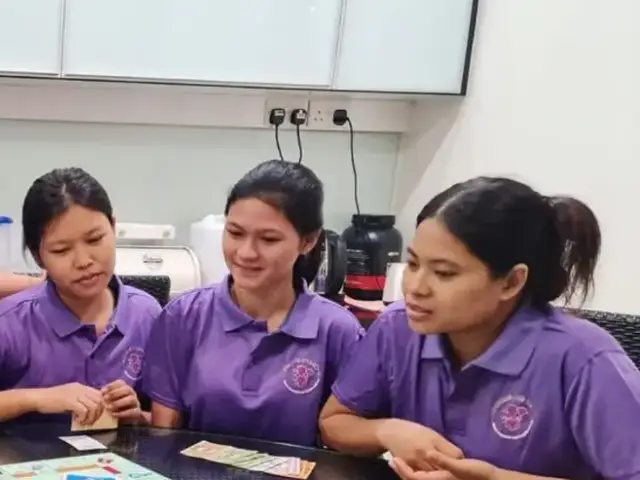
What Myanmar maids are like
- First language is usually Burmese
- Many have basic English, and some pick up simple Mandarin over time
- Skills vary, so check childcare, cooking or eldercare experience at interview
- Agree house rules, rest days and routines clearly in the first weeks
Suitable for: Families happy to give clear, simple instructions in the first weeks · Households looking for help with chores, childcare or eldercare
Need an extra pair of hands to tidy up the house? A Myanmar maid can be a good addition to a Singapore home. Many of the candidates we meet are keen to learn and to adapt to a household’s routines, although, as with any helper, attitude and experience differ from one person to the next. On this page we explain what to expect, how hiring works under MOM rules, what it costs and how to help your new helper settle in.
Helpers from Myanmar usually speak Burmese, though many also have a basic understanding of English. Some may be able to learn simple Mandarin or other dialects over time. Families who interview them often look for a helper who is open to adjusting to a new home and a different culture, and this is worth exploring with each candidate.
In addition to household chores, many have caregiving experience, which can suit families with young children or elderly members. Ask each candidate about the people she has cared for before, so you can judge how well her experience matches your family’s needs.
DISCLAIMER: Ultimately, maids are individuals with their own strengths and weaknesses. Other factors like work experience, age, education and training should also be considered when hiring a maid.
Who a Myanmar helper may suit
Every candidate is different, so we match on the person rather than the passport. That said, families often ask us about Myanmar helpers when they want:
- a full-time, live-in helper for general housework, cooking and laundry;
- someone patient to help with young children or to keep an older parent company;
- a helper who is open to learning the household’s own way of doing things;
- a candidate whose language skills fit a home where simple English is spoken.
If the job involves heavy personal care for an elderly parent, such as transfers or help with bathing, ask for candidates with that specific experience and read our page on elderly caregivers. For a household with a newborn, see our newborn and confinement care placements. You can also compare nationalities in our guide to choosing between Filipino, Indonesian and Myanmar helpers.
MOM rules for Myanmar maids in Singapore
Myanmar is one of the approved source countries for migrant domestic workers in Singapore. MOM’s helper eligibility rules apply to every candidate:
- she must be female and aged 23 to below 50 when the Work Permit is applied for;
- she needs at least 8 years of formal education with a recognised certificate;
- she must work at the employer’s registered address and must not be related to the employer.
As the employer, you must be at least 21, not an undischarged bankrupt, and able to fulfil an employer’s responsibilities. MOM also looks at your household’s ability to hire and house a helper. It does not publish a fixed income figure, so we will not quote one. See MOM’s employer requirements for the details.
Rest days, salary and living conditions
Your helper is entitled to one rest day a week, and at least one rest day each month cannot be compensated away. If she agrees to work on her other rest days, you pay at least one day’s salary for each, which is her monthly salary divided by 26. MOM sets no minimum salary, but you must pay the salary declared in the Work Permit application, no later than 7 days after the end of each salary period.
Her accommodation must protect her from sun, rain and wind, with adequate space and privacy, and she must not share a bedroom with a male adult or teenager. You should not keep her passport, as withholding someone else’s passport is an offence, and MOM’s guidance treats her phone as her personal property. Our summary of MOM regulations for domestic helpers covers these points in more depth, and MOM’s rest day guidance is the official reference on rest days.
How hiring a Myanmar helper works, step by step
Behind the shortlist and interview, there are several MOM steps. This is the usual order for a helper coming from overseas:
- Attend the Employers’ Orientation Programme. First-time employers must complete the EOP at least 2 working days before the Work Permit application. The online version takes 2 hours and the classroom version takes 3 hours.
- Apply for the Work Permit. The application is made through FDW eService and usually takes about a week to process.
- Buy the security bond and insurance. A $5,000 security bond must be in place before she arrives, along with medical insurance and personal accident insurance that meet MOM’s minimums.
- Arrival and medical check. She must pass a medical examination by a Singapore-registered doctor within 2 weeks of arrival.
- Settling-in Programme. A first-time helper attends this one-day course within 7 days of arrival, excluding Sundays and public holidays, and can only start work after attending it.
- Work Permit issued. Once the steps are complete, the Work Permit is issued and she can begin work in your home.
We guide you through this paperwork, and our helper transport service can cover airport pickups and medical runs. For a fuller walkthrough, read our step-by-step Work Permit guide or MOM’s own application page.
What it costs to employ a helper from Myanmar
Government costs are the same for every nationality. Based on MOM’s published figures:
- Monthly levy: $300 for your first helper and $450 for each additional helper. The concessionary rate is $60 if your household qualifies, for example with a Singapore citizen child under 16 or an elderly person aged 67 or above, under MOM’s levy concession rules.
- Work Permit: a $35 application fee and a $35 issuance fee.
- Security bond: $5,000, as a banker’s or insurer’s guarantee.
- Insurance: medical insurance with an annual claim limit of at least $60,000, and personal accident cover of at least $60,000. You cannot pass the cost of medical insurance on to your helper.
- Courses: the online EOP costs $29 to $36 and the classroom EOP $35 to $76. The Settling-in Programme costs $76.40 to $92.65 depending on the provider, and the employer pays.
- Medical checks: you pay for her six-monthly medical examination and any medical costs arising from it.
The biggest variable is salary. It is agreed with each candidate and depends on her experience, skills and the job scope, so a helper with years of childcare or eldercare experience may expect more than someone newer to overseas work. Our guides to maid salary in Singapore and the full cost of hiring a maid go into more detail. If the placement ends within the first 6 months, MOM requires agencies to refund at least 50% of the employer’s service fee, subject to conditions set out on MOM’s refund page.
Budget and training
Actual pay depends on experience, skills and the job scope. Some candidates are newer to overseas work, so a little extra guidance in the first weeks helps. Clear routines, demonstrations and simple written checklists help her settle into your household’s way of doing things. We also pre-train helpers before placement, so she arrives with a head start on the basics.
Preparing for her arrival and the first few weeks
A good start makes a big difference. Before she arrives, get her room or sleeping area ready with a mattress, pillow, blanket and toiletries, and decide which tasks matter most in her first week. Our home preparation checklist walks through the details.
Tips for the first month
- Show each task once, then let her try while you watch, rather than explaining everything on day one.
- Use short sentences and simple English, and check understanding by asking her to show you rather than asking “OK?”.
- Write a simple daily timetable and stick it somewhere visible.
- Agree her rest day early and record it in FDW eService.
- Let her contact her family regularly. Homesickness is common in the first weeks, and our guide on handling homesickness has practical ideas.
Most households find that patience in the first month pays off later, once she knows the routines and the family’s preferences.
New helper or transfer helper?
A helper coming from Myanmar for the first time will need the full onboarding process, including the Settling-in Programme. A transfer maid is already working in Singapore, knows how local homes run and can often start sooner, but the transfer needs her current employer’s consent. Both routes can work well, and we can share profiles of either. Browse our available maids or ask us to send Myanmar helper profiles that fit your home.