Singapore families juggle demanding jobs, school runs, ageing parents and a home that never quite stays tidy. Hiring a helper who is already working here is one of the quickest ways to get support in place. This guide sets out the seven main benefits of transfer maid hiring, the MOM rules that shape the process, and the honest trade-offs, so you can decide whether it suits your household.
A transfer maid is a migrant domestic worker who is already in Singapore on a Work Permit with another employer and is moving to a new one. Some move because a contract is ending, others because the family is relocating overseas, the children have grown up, or an elderly parent they cared for has passed away. The reason matters, and we return to it below.
Transfer hiring is not automatically better than bringing in a new helper from overseas. It is different. For some families the speed and local experience are decisive. For others, the chance to train someone from scratch is worth the longer wait.
We have kept this guide practical and linked to the official MOM pages throughout, so you can check the rules for yourself.
The 7 benefits of transfer maid hiring at a glance
- Lower upfront costs, with no airfare from overseas.
- Local experience and professionalism in Singapore homes.
- A better fit for specific needs such as childcare or elderly care.
- Familiarity with Singapore life and, often, with English.
- Agency support through the transfer paperwork.
- A track record you can check, including an in-person interview.
- Safety and compliance checks already in her history.
Each is explained below, with the caveats that come with it.
1. Lower upfront costs
Because a transfer maid is already in Singapore, there is no airfare to bring her in from overseas, and some of the first-time steps fall away. MOM’s Settling-in Programme, a one-day course costing $76.40 to $92.65 that the employer pays for, is required only for first-time helpers. A helper who has already worked here has typically completed it.
The trade-off is salary. Experienced helpers often ask for a little more. MOM figures from 2019 and 2020 put the average salary of transfer hires at $610 and $630, against $570 and $590 for overseas hires, according to a written answer in Parliament. These figures are dated, but the pattern is a useful guide. MOM sets no minimum salary for helpers; you pay what you declare in the Work Permit application.
The fixed government costs do not change. You still pay the $35 application fee and $35 issuance fee, the monthly levy of $300 for a first helper (or $60 at the concessionary rate if you qualify), a $5,000 security bond, and medical insurance and personal accident insurance of at least $60,000 each a year. For a full picture, see our breakdown of maid costs in Singapore.
2. Local experience and professionalism
Many transfer helpers bring real experience of Singapore households: compact HDB kitchens, humid-weather laundry routines, wet markets and the rhythm of school and tuition timetables. That experience can show in cleaning, cooking, childcare and general household management, and some helpers can suggest better ways to organise storage or plan the week.
Experience varies, though. Two years in one household is not the same as two years doing the specific tasks you need. Ask what she actually did day to day, not just how long she worked.
3. A better fit for specific household needs
If you need help with something particular, such as a newborn, a toddler or an elderly parent, a transfer maid’s work history lets you look for directly relevant experience. A helper who has spent two years caring for a grandparent with limited mobility has practised routines a first-time helper has not. Many helpers also handle errands and grocery shopping as part of their duties.
For families with caregiving needs, we place helpers with elderly caregiving experience through our elderly caregiver service. Bear in mind that a domestic helper is not a nurse, and medical needs should be guided by your loved one’s doctor.
4. Familiarity with Singapore life and language
For expatriate families in particular, a helper who already knows how Singapore works can be a real help. She may know how to use public transport, where to shop, how local clinics and polyclinics operate, and what the neighbourhood routines look like. Transfer helpers come from many countries, including Indonesia and the Philippines, and many have built up conversational English through working here.
Language ability differs from person to person rather than by nationality, so assess it directly at the interview. Ask her to explain a routine from her current job in her own words.
5. Agency support through the transfer
The transfer itself follows a set MOM process, and a reputable agency, such as our transfer maid team, can handle much of it for you, including the paperwork, coordinating the medical check and getting the current employer’s consent. The key steps are:
- Check eligibility. Her Work Permit must be valid for more than 30 days, and her six-monthly medical examination (6ME) must be done.
- Request consent. The new employer requests consent through MOM’s FDW eService, and the current employer approves it. A current employer’s consent is required for a direct transfer.
- Apply for the Work Permit. A decision is usually given within about a week. If approved, you receive an in-principle approval (IPA).
- Prepare. Buy the security bond and insurance, and sign the declaration form with the helper.
- Issue the permit on the agreed date. The new Work Permit must be issued within 21 days of approval or before her current permit expires, whichever is earlier. The current employer pays the levy until it is issued.
If this is your first helper, you will also need to complete the Employers’ Orientation Programme at least 2 working days before applying. Our guide to how the MOM transfer process runs goes into each step in more detail.
6. A track record you can check
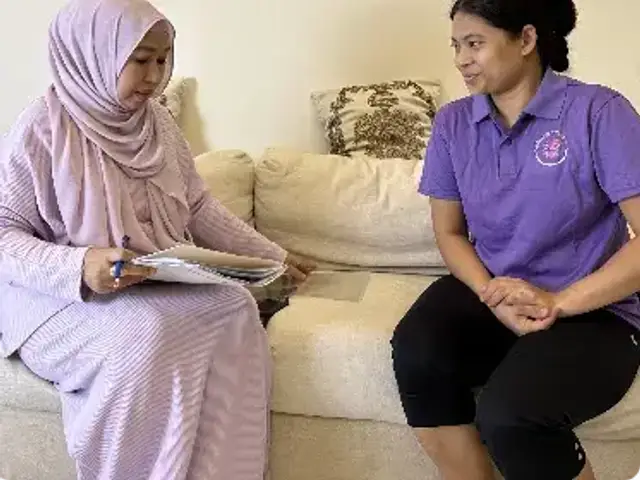
With a helper coming from overseas, you usually rely on a profile and a video interview. With a transfer maid, you can often meet her in person, see how she presents herself and ask detailed questions about her current role. Where the current employer agrees, you may be able to speak with them about her work.
Many transfer helpers are also looking for a stable, long-term placement, which can suit families who want continuity. A fair interview helps both sides. Useful questions include:
- Why is she leaving her current employer?
- What did a typical day look like, from morning to night?
- Which tasks did she enjoy, and which did she find hard?
- How were rest days arranged?
- What is she hoping for in her next household?
Treat references as one input, not the final word. A household that did not suit her may not reflect how she would do in yours. Our tips for selecting the right transfer maid go further.
7. Safety and compliance checks
MOM requires the helper’s 6ME to be completed before a transfer, so you start with a recent medical check on record. As her new employer you buy fresh cover for her: medical insurance with an annual limit of at least $60,000 and personal accident insurance with a sum assured of at least $60,000, under MOM’s insurance requirements. An agency can help you arrange these alongside the security bond.
Agency hiring also carries a protection worth knowing. For contracts from 1 June 2022, if the helper’s employment ends within the first 6 months, MOM requires the agency to refund at least 50% of the service fee, subject to conditions set out on MOM’s refund page.
Why hire a transfer maid, and when not to
The strongest case for a transfer is a household that needs capable help soon and values local experience. It also suits families who want to meet a helper face to face before deciding.
A transfer may suit you less if you want to shape every routine from scratch, if you have very specific expectations that clash with what she is used to, or if her current permit is close to expiry and timing is tight. Habits from a previous household can take some gentle unlearning. Our comparison of new maid vs transfer maid weighs both routes side by side.
If a helper is between employers while a transfer is arranged, our boarding house for helpers gives her a safe place to stay in the meantime.
Frequently Asked Questions
Is a transfer maid cheaper than a new maid from overseas?
Upfront costs are often lower because there is no airfare and first-time steps such as the Settling-in Programme fall away, but transfer helpers often ask for a slightly higher monthly salary, so compare the total cost over the contract.
Do I need the current employer’s consent to hire a transfer maid?
Yes. MOM requires the current employer’s consent before a helper can be transferred, and the new employer can only apply for the Work Permit once consent has been given through FDW eService.
How long does a maid transfer take in Singapore?
MOM usually gives a decision on the Work Permit application within about a week, and the new permit must then be issued within 21 days of approval or before the current permit expires, whichever is earlier.
Does a transfer maid need to attend the Settling-in Programme?
The Settling-in Programme is required only for first-time migrant domestic workers, so a helper who has already worked in Singapore will typically have completed it before.
Who pays the levy during a transfer?
The current employer keeps paying the levy until the new employer issues the new Work Permit, at which point the old permit is cancelled automatically and the current employer’s levy billing stops.
Conclusion
The benefits of transfer maid hiring are real: lower upfront costs, local experience, a work history you can match to your needs, familiarity with Singapore life, agency support through the paperwork, a track record you can check in person, and safety checks already on record. The trade-offs are a slightly higher salary, habits from a previous household, and a process that depends on the current employer’s consent and the permit timeline.
Approached with clear questions and realistic expectations, a transfer can get the right help into your home quickly. Rules do change, so confirm current requirements on the MOM website before you finalise anything.
If you are weighing up a transfer helper for your household, we can talk you through the options and the timeline. You can get in touch with the Femme5 team to discuss your family’s needs, read more about how we work with employers, or explore what a good placement looks like.
The Femme5 Team
Maid placement specialists, Femme5 Maid Agency
Our consultants work with Singaporean and expatriate families on helper matching, contracts and MOM compliance, and we verify the regulatory guidance in our articles directly against the Ministry of Manpower’s published requirements.